
Services and Amenities
Furniture and Utilities
- Bed
- Desk
- Chair
- Closet/wardrobe
- Microwave and mini-fridge
- Couch
- Coffee table
- TV stand
- Dining table and chairs
- Kitchen appliances/microwave and mini-fridge
- Bed
- Desk
- Chair
- Closet/wardrobe
Live-In Staff
Community assistants (CAs) are full-time SDSU students who have had intensive training on various issues that affect upper-class students (sophomores and above). CAs serve as facilitators for community building and are available to listen to your concerns and help you seek additional help when necessary. CAs are also responsible for bringing inappropriate conduct to a resident’s attention.
Community interns (CIs) are the student staff members of the management office responsible for assisting you with customer service, leasing information, general property information, processing mail, work orders, maintenance concerns and enforcing expectations related to policies and procedures.
Desk assistants/security monitors are the front desk student staff members responsible for assisting you with customer service, monitoring the security of the building, disseminating information and equipment and enforcing expectations related to safety procedures.
General advisors and retention specialists (GARS) work inside the residential communities and provide academic advising and retention programs for students living on campus.
Residence hall coordinators (RHCs) are full-time, master-level professionals who live in the residential communities. The RHCs work with building staff and residents to provide a link to all university resources and to assist in developing a positive residential community. Every RHC supervises the resident advisors/community assistants who live on every floor of the community. The RHCs also advise the hall/community council, maintain community security, meet with students regarding student conduct issues and coordinate activities and programs.
Resident advisors (RAs) are full-time SDSU students who have had intensive training on a variety of issues college-age students encounter on a daily basis. RAs live on each floor of the residential communities and are available to listen to your concerns and help you seek additional help when necessary. In addition, RAs serve as facilitators for community building and regularly plan programs.
Faculty-in-residence serve as liaisons between SDSU faculty and students. These SDSU faculty members live in apartments located within the campus residential communities. They work closely and cooperatively with the residential staff. Together, they develop academic communities and meet the needs of residents by encouraging their intellectual stimulation and academic success.
Wi-Fi
Students may connect to Wi-Fi by joining the Eduroam network with their SDSUid. Guests may use SDSU_Guest to connect temporarily. In order to connect to Eduroam, follow the instructions on the Internet Access webpage. Housing does not offer any hard-wired connections.
Students may connect their smart devices (Smart TV, Xbox, Playstation, Apple TV etc.).
We do not support Wi-Fi printers. For personal printers, purchase a USB cable.
Before submitting a service request for Wi-Fi connectivity, try the following:
- Disconnect from Eduroam or SDSU_Guest and reconnect.
- Make sure there is no interference from a microwave, television, etc.
- Run a full antivirus scan.
- If using an older computer, make sure the wireless drivers are up to date.
If you are still unable to connect to Wi-Fi, submit a service request on the Housing Portal.
RezCon Contact Info:
- Phone: 619-594-4135
- Email: [email protected]
TV Streaming
On a Computer:
- Go to play.streeme.tv/login
- Select “Connect Your Provider” on the screen.
- Scroll down and select “San Diego State.”
- Enter your SDSUid and password.
On a Mobile Device:
- Download the Streeme TV app from the App Store or Google Play.
- Select “Connect Your Provider” on the screen.
- Scroll down and select “San Diego State.”
- Enter your SDSUid and password.
On a Big Screen:
For the big screen experience, set up Streeme TV on Roku, Amazon Fire or Apple TV.
Before submitting a service request for Streeme TV, make sure you are connected to the Eduroam Wi-Fi network (if watching via an internet browser) or the SDSU_Guest Wi-Fi network (if watching via a device such as a Roku or Amazon Fire).
If you are still unable to connect, visit streeme.tv/support
HBO Max
To watch HBO Max, students must be on campus and connected to the Eduroam or SDSU_Guest Wi-Fi network.
- Visit auth.hbomax.com/providers.
- In the "Search for your provider" box, search University Video Services.
- Select San Diego State University from the provider list of options.
- Log in with your SDSU credentials.
- Watch HBO Max! All the programming that you love is available 24/7.
To watch HBO Max, students must be on campus and connected to the Eduroam or SDSU_Guest Wi-Fi network.
- Open your HBO Max TV or Mobile application.
- Navigate to the login page and click "Create an HBO Max Account".
- In the "Search for your provider" box, search University Video Services.
- Select San Diego State University from the provider list of options.
- Log in with your SDSU credentials.
- Watch HBO Max! All the programming that you love is available 24/7.
Before submitting a service request for HBO Max, make sure you are connected to the Eduroam Wi-Fi network (if watching via internet browser) or SDSU_Guest Wi-Fi network (if watching via a device such as a Roku or Amazon Fire).
If you are still unable to connect, submit a service request in the Housing Portal.
Wepa Printing Kiosks
- Chapultepec lobby
- South Campus Plaza—North second-floor lounge
- South Campus Plaza—South second-floor lounge
- Tenochca lobby
- Cuicacalli east hallway
- Texcoco lobby
- University Towers lobby
- Zura's first-floor lounge
- Villa Alvarado community room
- Black and white single-sided: $.08 per page
- Black and white double-sided: $.15 per page
- Color single-sided: $.25 per page
- Color double-sided: $.35 per page
Parking and Transportation
In support of sustainability initiatives, incoming first-year students who live on campus will not be permitted to bring a car the first year of study at SDSU. For more information, visit the First-Year On-Campus Resident Parking Policy webpage.
- Aztec Corner, Granada, Piedra del Sol, Sunset Plaza, Mixquic, Toltec, Texcoco, Zacatepec, Zapotec, and Viva:
Students residing in these buildings may reserve parking in their residential community. Note: Parking is limited. Parking permits for the 2026-27 academic year will be available starting Wednesday, July 15. - South Campus Plaza (Sophomore and Transfer Only), Tacuba, Tepeyac, Texcoco (Transfer Only) and Villa Alvarado:
Students residing in these buildings may purchase a 24-hour SDSU parking permit for Parking Structures 3, 4 and Lots 17/17A/17B. For details regarding 24-hour parking permits and structures, visit the Student Parking webpage. - M@College:
Students residing in M@College for the 2026-27 leasing term should email [email protected]. In the email, include your first and last name, phone number, your unit number and bed assignment at M@College. At this time, only tandem permits are currently available, but residents can request to be added to the waitlist for single permits by emailing the address above.
- SDSU offers a variety of transportation programs, discounts and mobility services to help you get around campus, San Diego and beyond.
- SDSU Safe Ride offers free, on-demand rides between more than 30 locations between 7 p.m.–3 a.m.
- Take the San Diego MTS bus and trolley systems conveniently from the SDSU Transit Center on campus. Discounted transit passes are available via the Transportation Portal.
- Take advantage of other rail student discounts on MetroLink and Amtrak for trips throughout California.
- Shared mobility devices are available around campus for quick and easy trips. SDSU student discounts are available when creating a Spin account using your SDSU email address.
- Designated Lyft and Uber pick-up/drop-off points are available at key campus locations for your convenience and safety.
- SDSU has also partnered with Zipcar, a car-sharing service available to students 18 years and older. Membership starts at just $25. Email [email protected] for a discount code or direct message us on Instagram @SDSUTransportation while supplies last.
More information can be found at SDSU's Transportation Services webpage.
Laundry
Communal laundry rooms are available in each residential community, except Granada, M@College and Viva, which have in-unit washers and dryers.

- Pay using either the WASH-Connect app (available for Apple or Android) or purchase a laundry card from a kiosk at the Cuicacalli or Huaxyacac front desk.
- Funds may be added to the WASH-Connect app with a credit or debit card. Laundry cards can also be loaded at the kiosk using a credit or debit card.
Washer:
- Add ¼ cup detergent or one laundry pod to the cylinder.
- Load clothes loosely; be sure to stay below the maximum fill line.
- Select your desired temperature, soil and fabric settings.
- Use your desired payment method.
- Press the start button. Note: Some machines will start once fabric settings are selected.
- After use, keep the order open to keep the machine fresh.
Dryer:
- Clean the lint screen.
- Load one wash load and close the door.
- Select your desired temperature and fabric settings.
- Use your desired payment method.
- Press the start button. Note: Some machines will start once fabric settings are selected.
All residence halls, excluding Aztec Corner:
- $1.25 per wash | $1.00 per dry
Aztec Corner:
- $1.75 per wash | $1.50 per dry
Review the Best Practices guide for helpful laundry tips.
If you need help with the laundry machines, you can submit a service request through the WASH-Connect App, visit wash.com/service or call WASH at 800-342-5932.
Residents of Granada, M@College and Viva:
In-unit washer and dryers in Granada, Viva and M@College do not require the WASH-Connect app. Be sure to clean the lint trap after every drying cycle to ensure safety and efficiency.
Safety and Security
- All residents must utilize their SDSUcard to access the front doors and gates of their residential community.
- First-year residents must present their SDSUcard and/or building identification to the front desk staff every time they enter their residential community. All residents must present their SDSUcard if asked by a university official.
- Guest policies strictly enforced in the residential communities.
- 24/7 front desk operations in first-year communities and some sophomore and upper division communities. Front desk hours in our apartment communities are 10 a.m.–7 p.m.
- Resident advisors and community assistants are on duty daily from 7 p.m.–7 a.m. for emergency needs.
- Desk assistants/security monitors staff the community front desks to provide assistance to residents, monitor the security of the building and communicate expectations related to safety procedures.
- All rooms, suites and apartments are subject to regular safety and maintenance inspections.
- All first-floor rooms have university-provided window/door security screens for the security of residents.
- Fire alarm systems in the residential communities are reliable and use state-of-the-art technology. The campus fire alarm network is monitored by University Police.
- Security cameras monitor indoor and outdoor communal areas.
- The San Diego State University Police Department (UPD) provides 24/7 policing services for the campus community, which includes campus residential properties.
- UPD has a designated residential housing officer (RHO) to serve as a liaison between the police department and residential housing community. The purpose of the RHO is to identify crime prevention methods tailored to the residential community, engage residential community members through educational events and training and collaboratively identify solutions for safety-related concerns and trends.
- UPD works hard to ensure that residents are aware of safety issues that may affect them. SDSU has established a text notification system that is capable of sending text (also known as SMS) and email messages in the event of a campus-wide emergency or health and safety concern.
- Additionally, the university launched the SDSU Safe App, a new, free phone app to promote and address personal safety on and off campus. SDSU Safe is available for download on Apple and Android devices.
- UPD has a Crime Prevention Programs webpage dedicated to information about emergency and non-emergency contacts, a safety-scenario guide and safety tips.
In accordance with the Higher Education Opportunity Act, the SDSU Annual Fire Safety Report contains information about fire safety policies, practices and statistics in on-campus housing facilities.
Bike and Electric Micromobility Device Storage
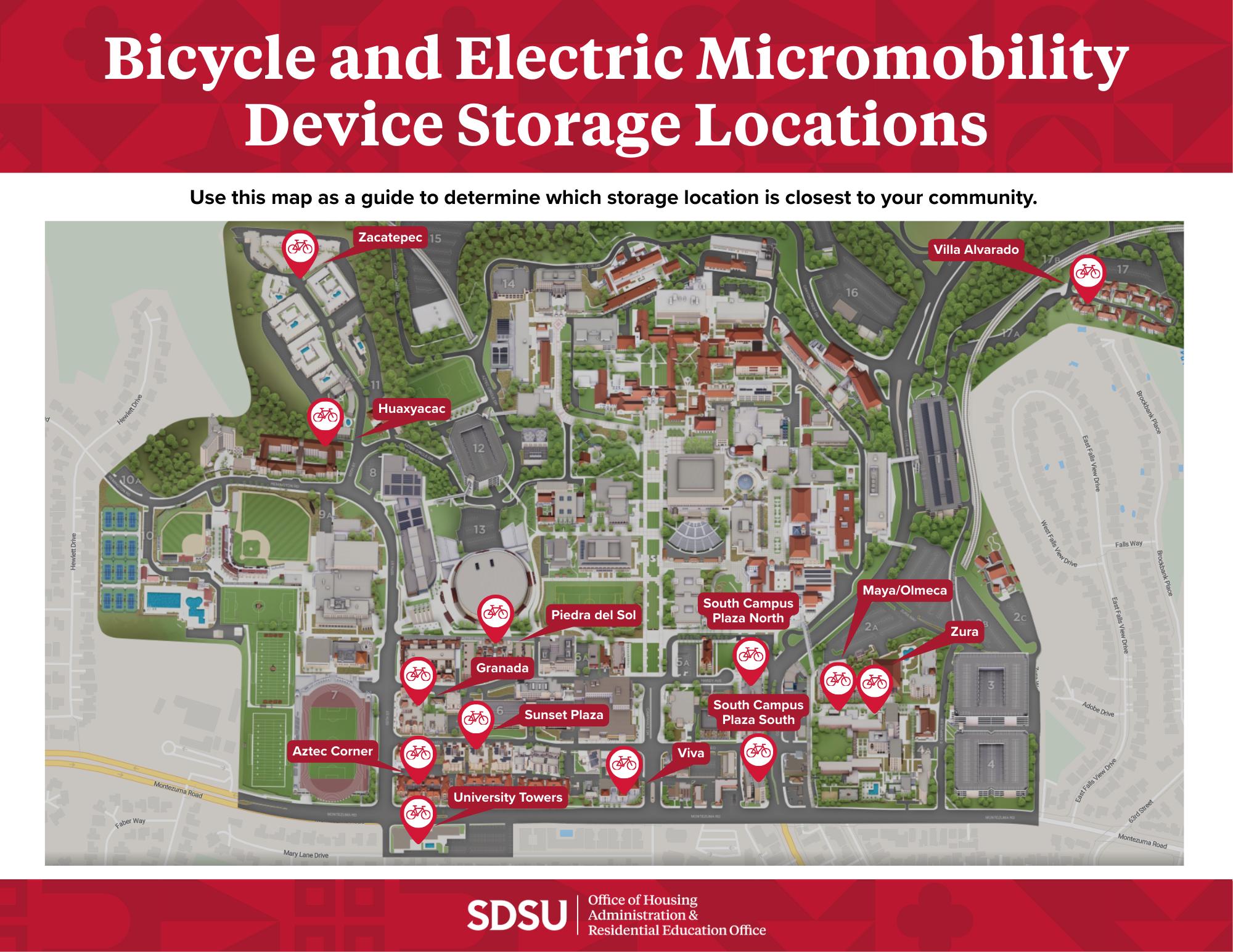
Bikes and electric micromobility devices are not permitted inside student rooms. Bike and electric mobility device storage is available to on-campus residents at no additional charge. Each storage area includes space to secure and charge bikes and electric micromobility devices.
For safety reasons, both non-electric and electric bicycles, scooters and their associated batteries are NOT permitted inside any residential buildings, including student rooms. They must be stored and charged only in designated micromobility storage areas near the communities.
Storage for bicycles and electric micromobility devices is available on a first-come, first-served basis. We recommend registering bike and electric micromobility devices with Transportation Services prior to obtaining storage access. If storage is available, residents will receive an email notification once access with their SDSUcard is activated.
Bike and Electric Micromobility Device Storage Form
Bike and Electric Micromobility Device Storage Locations:
- Aztec Corner
- Calexico Commons (SDSU Imperial Valley Calexico Campus)
- Granada
- Huaxyacac
- Maya/Olmeca
- Piedra del Sol
- South Campus Plaza North
- South Campus Plaza South
- Sunset Plaza
- University Towers
- Villa Alvarado
- Viva
- Zacatepec (Mixquic, Texcoco, Toltec, Zacatepec, Zapotec)
- Zura
M@College Residents: Bike and micromobility device storage is available with your key fob on the first level (P1) of the parking garage near the elevator. You must have a lock for your bike/device. Reach out to the M@College Office for additional information.
Renters Insurance
We encourage residents to obtain renters insurance for their bike or electric micromobility device. SDSU partners with GradGuard to offer renters insurance and protection for personal property, including electronics. Visit gradguard.com for more information.
Lithium-Ion Battery Safety
Lithium-ion batteries are commonly used in everyday items such as smartphones, laptops and portable battery packs. While these batteries are efficient and compact, they can pose serious safety risks when damaged, misused or improperly charged.
- Stay Alert for Warning Signs: Discontinue use or charging of any lithium-ion battery if you notice unusual smells, overheating, physical changes like swelling or leaking, performance problems or physical damage.
- Follow Battery Safety Tips: Only purchase products that are certified by recognized safety standards (such as UL certification). Always use the original charger provided by the manufacturer or one that is compatible in voltage and amperage. Avoid overcharging by unplugging your device once it’s fully charged, and never leave devices unattended while charging.
- Be Aware of Environmental Factors: Lithium-ion batteries should not be charged in extreme temperatures. Avoid charging below 32°F or above 105°F
- Follow Proper Battery Disposal Guidelines: Never discard lithium-ion batteries in the trash or regular recycling bins, as they contain hazardous materials and must be recycled properly. Residents may drop off used batteries at their community front desks for proper disposal.
Surfboard Storage
Surfboard storage is available to on-campus residents at no additional charge. You may submit interest in a surfboard locker via the Surfboard Storage Form. Due to limited availability, surfboard lockers will be assigned by lottery. Surfboards may also be stored in rooms (PDF).